Will Your Mug Fit? Cup Clearance Under Espresso Machines and Grinders
A machine can look roomy and still leave no space for your favorite mug. Measure the cup, measure the gap with the portafilter locked in, and plan for a scale, a pitcher or a catch cup sharing the same space.
Affiliate disclosure: CoffeeGear is reader-supported. When you buy through links on our site, we may earn a commission at no extra cost to you. We don't list prices because they change, so check the current listing and the seller's return window before you order.
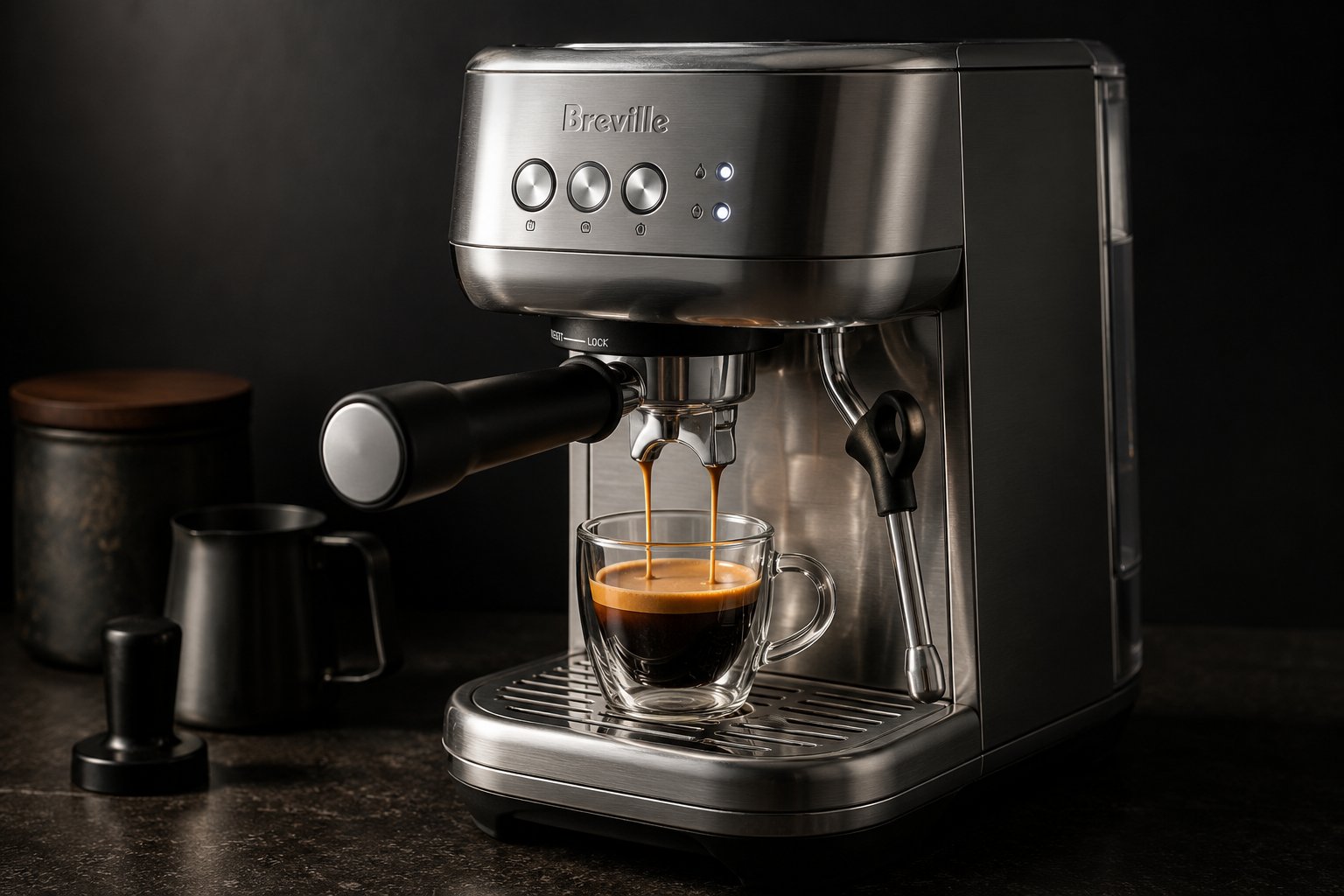
A mug fits under an espresso machine only if the gap between the lowest point of the portafilter and the drip tray grate is taller than the mug, with room left for the stream to land inside the cup. Most spec sheets do not give that gap, so the reliable check is to measure the cup you actually use and compare it with the machine's real clearance before you buy.
The same question applies to grinders that drop grounds into a catch cup, a dosing cup or a portafilter. This guide covers the machine gap, the steam pitcher, the grinder outlet and the small things that quietly eat height, like a scale.
What the manuals actually say about cup height
Cup height is one of the least documented numbers in the espresso world. Here is what a handful of maker documents say.
- The Breville Barista Express (BES870XL) booklet lists "extra-tall cup clearance for tall mugs" among its features, but gives no height. It also warns not to place anything other than cups for warming on top of the machine.
- The Breville Barista Express Impress booklet tells you to place pre-warmed cups under the portafilter and gives no cup-height limit. Its cup warming tray is a surface on top of the machine, not a rest for cups below.
- The De'Longhi EC935X manual lists a drip tray with a cup grill. It gives no maximum cup size and describes no way to adjust the tray height.
- The Gaggia Anima manual says you can lift or lower the coffee spout by hand to suit the size of your cups. It does not describe removing the drip tray for a taller cup.
- A Philips 3200 Series product sheet also lists an adjustable spout height.
The lesson is that "fits tall mugs" is a marketing phrase unless a number stands behind it. If a listing makes the claim without a figure, ask the maker or the seller for the clearance from the lowest part of the outlet to the grate.
Measure the cups first
Pick the vessels you will really use on a weekday morning, not the ones you own for guests. Then check each one against the trap in this table.
| Vessel | What to measure | Common trap |
|---|---|---|
| Espresso or demitasse cup | Outer height and rim width | A thick base or a saucer adds height, and a very narrow rim can let the stream miss |
| Tall latte mug | Full height with the handle on | The handle swinging into the portafilter handle or the back wall of the tray |
| Travel tumbler | Height without the lid and the opening width | A narrow opening that the stream does not land in cleanly |
| Milk pitcher under the steam wand | Height and width of the pitcher you use | The wand sits over the drip tray, so the pitcher shares the same space as your cups |
| Scale under the cup | Scale height plus cup height | A scale adds height that never appears on the machine spec |
| Grinder catch or dosing cup | Gap between the grinder outlet and its base | A cup taller than the space under the outlet, so it will not slide in or grounds spill over the lip |
Write the numbers down. If you are comparing machines, the same list works as a quick filter before you read any reviews.
Measure the machine, not the picture
Set the portafilter in the group as if you were about to pull a shot. Then measure from the top of the drip tray grate straight up to the lowest point under the portafilter spouts. If you do not own the machine yet, ask the seller or maker for that gap, or find a photo with a cup in frame and treat it as a rough guide only.
- Check the machine with the drip tray in place and the grate on top, since that is how you will use it.
- Allow a little extra height so you can slide the cup in and out without touching the portafilter.
- Check the width as well as the height. A tall cup with a handle needs room to turn.
- If the machine has a hot water outlet or a steam wand that you use with cups, check those positions too. The Breville booklets say to place the steam wand over the drip tray and away from people before you turn the steam on.
If the gap is too tight
You have a few sensible options before you give up on the machine.
- Brew into a small cup, then pour. A short cup or glass fits almost anywhere, and you can transfer the drink to your mug.
- Use an adjustable spout. Some bean-to-cup machines let you move the outlet up and down. The Gaggia Anima manual describes lifting or lowering the spout by hand. See our super-automatic buying guide for what else to compare on those machines.
- Swap the scale. A flat, low-profile scale gives back height that a chunky one takes.
- Do not assume you can remove the drip tray. The manuals above describe it as removable for emptying and cleaning, not as a way to fit a taller cup. Ask the maker before you run a machine without it, since drips and splashes then land on the counter.
Espresso cups or double-wall glasses
Short cups fit almost any machine and let you pour into a larger mug afterwards. Check the outside height before you order.
A low-profile coffee scale
A thin scale keeps more room under the outlet. Compare its height with the gap you measured.
For cup shapes and materials, our espresso cup guide covers the options in more detail.
Grinders, pitchers and the rest of the station
On a grinder, measure from the outlet or portafilter holder down to the surface the cup stands on. A grinder that fills a portafilter directly has a fixed gap that suits the portafilter handle, so a tall dosing cup may not fit under it. Check the maker's description of what the grinder fills and what accessories fit.
A steam pitcher needs height too, plus room to tilt. If you also plan to fit the machine under cabinets, remember the cup, pitcher and scale all add height to the work area; our cabinet clearance check covers that side. If you are still choosing a pitcher, this pitcher guide compares sizes and spouts, and the accessories checklist shows what else is likely to crowd the counter.
A small stainless steel milk pitcher
Pick one by its height and width against your steam wand position, not only by its volume.
One more check that costs nothing: set your tallest mug where the cup will go and look at the stream path. The coffee should fall inside the cup without hitting the rim. If it does not, adjust before you buy.
Frequently asked questions
How much clearance is there under an espresso machine?
It varies by machine, and many manuals do not give a figure. Measure from the drip tray grate to the lowest part of the portafilter, or ask the maker.
Can I use a travel mug under my espresso machine?
Only if it fits in the gap with the portafilter locked in and the opening is wide enough to catch the stream. Measure it first, and brew into a small cup if it does not.
Can I remove the drip tray to fit a tall cup?
Do not assume so. The manuals checked describe the tray as removable for emptying and cleaning, so ask the maker before running the machine without it.
Does a scale on the drip tray reduce clearance?
Yes. Any scale under the cup adds its own height, so measure the scale and the cup together, or choose a low-profile scale.
Do tall mug claims in listings mean a specific height?
Not unless a number is given. Ask the maker or the seller for the clearance between the outlet and the drip tray grate.
- Breville Barista Express (BES870XL) instruction booklet: "extra-tall cup clearance for tall mugs" listed as a feature, with no dimension; removable drip tray; do not place anything other than cups for warming on top of the machine.
- Breville Barista Express Impress instruction booklet: cups placed under the portafilter; no cup-height limit; steam wand positioned over the drip tray.
- De'Longhi EC935X manual: drip tray with cup grill; no cup height, maximum cup size or tray adjustment described.
- Gaggia Anima (120V) user manual: coffee spout can be lifted or lowered by hand to suit the cup size; tray described as removable for cleaning and descaling.
- Philips 3200 Series (EP3241/74) product sheet: lists an adjustable spout height. It is a marketing sheet, so treat it as the maker's description.
- No cup heights, clearances or machine dimensions are quoted in this article. Get the gap for your model from the maker, and check your own cups against it.